Rosita Najmi learned a myriad of skills in her time with Tennessee 4-H. While she focused on three projects – public speaking, leadership and citizenship – she also came away with practical life skills, like writing thank-you notes, barbecuing chicken and record keeping.
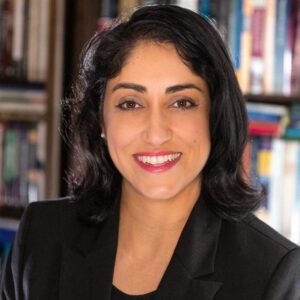
Rosita Najmi
“It helped me understand Tennessee, Southern and American cultures,” she says. “The 4-H community was a bridge for me as a refugee and immigrant. It really helped me find a place to belong.”
Now serving as the executive director of Micron Foundation and global head of social impact and community engagement at Micron, a global semiconductor company, Najmi has spent her career of over 20 years working to better the lives of others through social, environmental and economic development.
In late 2023, when she was invited to give a TED Talk, she titled her speech, “What’s Your Leadership Language?” and focused, in great part, on her leadership journey, which began in 4-H with leadership roles at the regional and state councils, including Tennessee 4-H Governor. Through the Tennessee 4-H program, Najmi discovered the “Five Practices of Exemplary Leadership.” The practice of challenging the process, which encourages moving outside the boundaries to be innovative and make change, particularly resonated and stuck ever since.
Watch Najmi’s 8-minute TED Talk and find a list of resources that inspired her through the link below.
Rosita’s Roots
Najmi was just a toddler when her family fled Iran’s 1979 revolution to take refuge in the U.S. A few months later, they moved to Knoxville, where Najmi’s older siblings could attend the engineering program at the University of Tennessee.
She discovered 4-H in fourth grade thanks to Nancy Tucker, a local mother of four who included Najmi in her youngest daughter’s activities. The 4-H pledge had a big influence on her. The “head, heart, hands and health” pledge encouraged her to put ideas into action towards the betterment of others in her club, community, country and the world. The pledge guided her to realize big truths, even as a youth.
“I was a part of something bigger and could have an impact nationally in the U.S., but even broader in my global community,” Najmi says.
Her Hands for Larger Service
Even before she entered the work world, Najmi was devoted to making a difference. As 4-H Governor, she led the first service project component of State Congress, which was part of the statewide literacy project R.E.A.D. (Reach, Encourage and Develop) TN that she started during her tenure as Governor.
In her hometown, Najmi was selected to serve on the Youth Action Council that helped establish Knoxville as a City of Promise under General Colin Powell’s youth development nonprofit, America’s Promise.
“I recruited 4-H’ers to serve on the Action Council and community Days of Service we hosted because it was such a good fit with what 4-H’ers were already doing for either citizenship or leadership projects. It was already in their DNA,” she says.
See more: Phyllis Ferguson Is the 2025 Friend of 4-H
Through a program at her local PBS affiliate, she produced a one-hour documentary on racism. At her high school, she championed environmental stewardship by running a telephone book recycling drive. In her undergraduate studies at Wake Forest University, she co-founded a nonprofit that addressed a public health crisis in Benin, West Africa, which took medical supplies and built a community clinic. She also founded an annual service trip to Vietnam, which financed and helped build primary school houses in the Mekong Delta.
In addition to these service projects, Najmi drew inspiration from leaders, including Dr. Maya Angelou, under whom Najmi studied as a college senior. While the class was focused on poetry, Najmi also came away with insights on social justice leadership and how the arts can be a powerful tool in effective leadership and influence. After a few years at nonprofits and the World Bank, she went on to earn her MBA at Harvard and started her tenure as a funder first in private philanthropy at the Omidyar Network and the Gates Foundation. Then, she transitioned to corporate philanthropy in 2020, with PayPal and UPS.
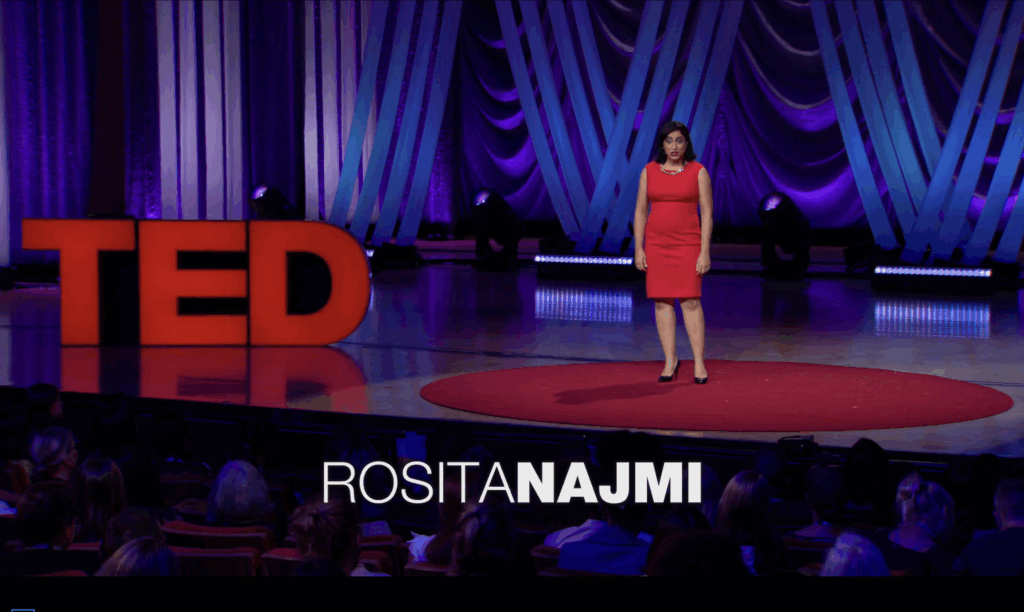
Rosita Najmi’s Ted Talk; Photo credit: Ted Talk
Stage Presence
Najmi had been a long-time consumer of TED Talks and had used the speeches in team-building activities and workshops. But, she admits, “I never thought I would deliver one.”
By the time she got the opportunity, she’d already been thinking about the tensions of adapting to fit in with the culture of an organization and being an authentic leader.
“I also was observing that complex issues like climate, gender equality and data need leaders from not one sector alone,” she says. “To solve these issues, we need leaders who understand the perspectives and nuances from the academic sector, the private sector, the public sector, civil society and philanthropy.”
Effective leaders also require an ability to meet people where they are and speak their language, no matter how that might differ from their own.
See more: Family Footsteps Lead to 4-H Leadership Roles
“The development and delivery of the TED talk was really an amazing experience,” Najmi says. As she walked on the stage, she remembered techniques she honed while delivering speeches in 4-H. “It was fun to see which jokes landed with the audience, and which didn’t. What was most meaningful was hearing people’s reactions to it.”
Najmi was struck by the number of people who commented about her TED Talk on LinkedIn and shared their own take on the topic.
“I heard from people all over the world, including Brazil and Turkey, and in different languages,” she says. “They posted comments where they discussed what resonated with them and made connections to how they thought about leadership. The experience reminded me of the 4-H pledge. I had shared what was in my head and heart and reached a global community.”
4-H Foundations
Najmi is grateful to her 4-H mentors for continuing to show friendship and compassion over the years.
“I was a little Persian girl in Knoxville, Tennessee, and my life would’ve been very different and more difficult if the 4-H community had not included me and supported my ideas and passions,” she says. “My extension agents – Rosalind Woodard, Carlene Welch, Danny Bullington – and staff at the district and state levels – Alice Ann Moore, Carmen Burgos, Ruth Henderson and Steve Sutton – were other parents to me. They wrote letters of support for college admissions and scholarships, came to my wedding and my mom’s funeral, and now send my children birthday cards. It was way more than a job for them, and they treated us 4-H’ers like children of their own.”
To all young 4-H members, she says, “Do a project that you’re excited about, and not necessarily one with which you’re familiar. Pick topics and experiences that might push you outside of your comfort zone and give it your all. There’s no right or wrong project. Regardless of which one you pick, you will learn and grow.”