One of Mattie Smith’s favorite memories of growing up on her family’s farm in Ten Mile is of bottle-feeding an orphaned calf. Her agriculture background and 4-H career led her to Washington D.C. to advocate for agriculture.
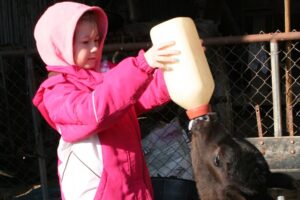
“I remember getting up at 5:30 in the morning, and I’d ride my bicycle across the road to my grandparents’ house, to the barn, and I would have a warm milk bottle waiting on me to feed it,” says Smith, a now 18-year-old 4-H’er. “Then I’d run back to the house before school, get out of my dirty, milk-covered overalls and go to school, come right back home from school and my mom would drop me off back at the barn to go feed the calf again that afternoon.”
See more: Katie Collins is a Role Model for All 4-H’ers
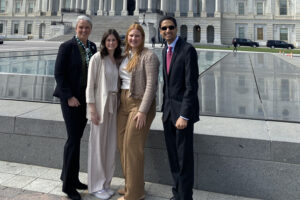
In March of 2024, Smith, a fifth-generation farmer who is studying agricultural communications at Tarleton State University in Stephenville, Texas, shared her memories and her strong opinions about the importance of family farming with 4-H youth and administrators, other agricultural leaders, and members of Congress as part of National Agriculture Week.

A Multi-Generational Farm
Smith belongs to the youngest of three generations of Bratcher Family Farms descendants who currently reside on the farm her great-great-grandfather started decades ago. Together, they raise Black Angus beef cattle and hay on 400 acres. “Everyone from my grandparents to my parents and all of my aunts and uncles, and when I was younger, all 12 of my cousins, were living and working on the farm full time,” says Smith, who goes home in the summer to help out. “I really did not realize, until I came to college, how many people have not seen or stepped foot on a farm, but also how so many farms operate so differently from ours. I’ve been truly blessed to have all of our family live on the farm and just step out on the back porch and get to look at the pasture and watch cattle.”
See more: Officers Advocated for 4-H on Ambassador Tour
Like other farm families, Smith’s has suffered its share of hardships, especially in recent years, with weather, inflation and the high price of fertilizer hurting an already-bootstrapped industry. Last year, the family was forced to downsize its herd from 80 to 40, a deficit that became more real to Smith when she returned home on a school break.
“I went to go check cattle alone and take some pictures, and I was counting the herd and I caught myself asking, ‘Where are the rest?’” she recalls. “That was a moment of realization that it had hit home.”
Heading to Capitol Hill
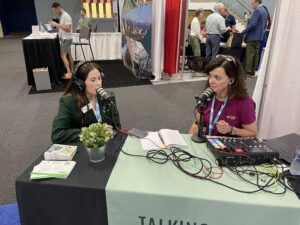
Several years ago, while giving a 4-H speech, Smith got the idea to produce a documentary showcasing the loss of family farms to development and how that negatively impacts mental health. She also appeared on a podcast about mental health resources for farming and ranching families and displayed her photography in a 4-H exhibit showcasing local beef cattle operations in East Tennessee.
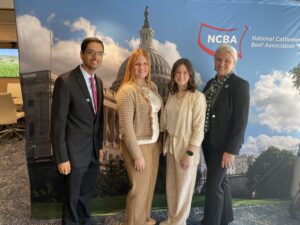
This year, Smith’s documentary-in-the-making, her lifelong involvement in 4-H, and her work in agricultural politics – she served as a 4-H state council member for two years – caught the attention of the National 4-H Council, which invited her to Washington, D.C., to advocate on behalf of Tennessee farmers. While there, she met with U.S. Secretary of Agriculture Tom Vilsack and members of his staff, encouraging them to preserve rural lands and make family farm operations more affordable.
Her message to all is, “This is not just a lifestyle that you see on a screen or read about. It’s a legacy we choose to continue, and it’s worth preserving whether you live on a farm or not. If you are clothed and you are fed, then it’s your responsibility to help us preserve it.”
The feedback, she says, was very positive, with one legislative leader telling her, “There are people who want to hear your stories and they want your perspective because you’re the experts. No one else is facing agriculture the way the youth are, with new technology coming and more and more colleges popping up with agriculture programs.”
See more: Discover 4-H Volunteer Opportunities
Smith recently found out she’ll graduate college a year early and is hoping to land a job in the communications field.
“But wherever that takes me,” she says, “I know I’ll always be tied to agriculture and the lifestyle that I love.”